A professional approach to acne, pigmentation and post-inflammatory hyperpigmentation in Fitzpatrick IV–VI.
Treating melanin-rich skin isn't simply about taking a conventional protocol and reducing the strength. Fitzpatrick IV, V and VI skin can respond differently to inflammation, heat, friction and aggressive resurfacing.
The challenge is to create meaningful correction without triggering another inflammatory response that leaves a new mark behind.
Why Melanin-Rich Skin Responds Differently
Darker skin doesn't necessarily have more melanocytes. The important difference is in the melanosomes they produce.
In deeper skin tones, melanosomes tend to be larger, more heavily melanized, more dispersed and slower to degrade. They can also respond readily to inflammation, trauma, heat, friction and UV exposure.
This means the goal isn't simply to ask, “How effectively can I resurface the skin?” It is also: “How can I create correction without unnecessarily stimulating more pigment?”
Inflammation Doesn't Always Look Red
Erythema can be harder to see in deeper skin tones, so redness alone isn't always a reliable measure of irritation.
Practitioners should also look for heat, tightness, itching and delayed reactions. Skin may not look dramatically irritated during treatment while still experiencing enough inflammation to stimulate pigmentation.
Acne + Pigmentation: Treat Them Together
For many clients with melanin-rich skin, the breakout isn't the biggest concern. It's the mark it leaves behind.
A single inflammatory lesion can leave pigmentation long after the acne has resolved. This means practitioners should think about acne as two interconnected concerns:
The lesion + the pigment response.
A treatment that clears acne but repeatedly creates excessive inflammation may simply replace one problem with another.
Stop Chasing the Strongest Peel
Some traditional signs of a “strong” peel are exactly what we don't necessarily want when treating pigmentation-prone skin.
- Don't chase frosting, intense stinging or excessive peeling.
- Minimize unnecessary heat, steam, friction and aggressive extraction.
- Don't treat pigment without supporting the barrier.
- Make home care part of the treatment plan.
A better philosophy is simple: less trauma, more control and more consistency.
What Does a Barrier-First Peel Look Like?
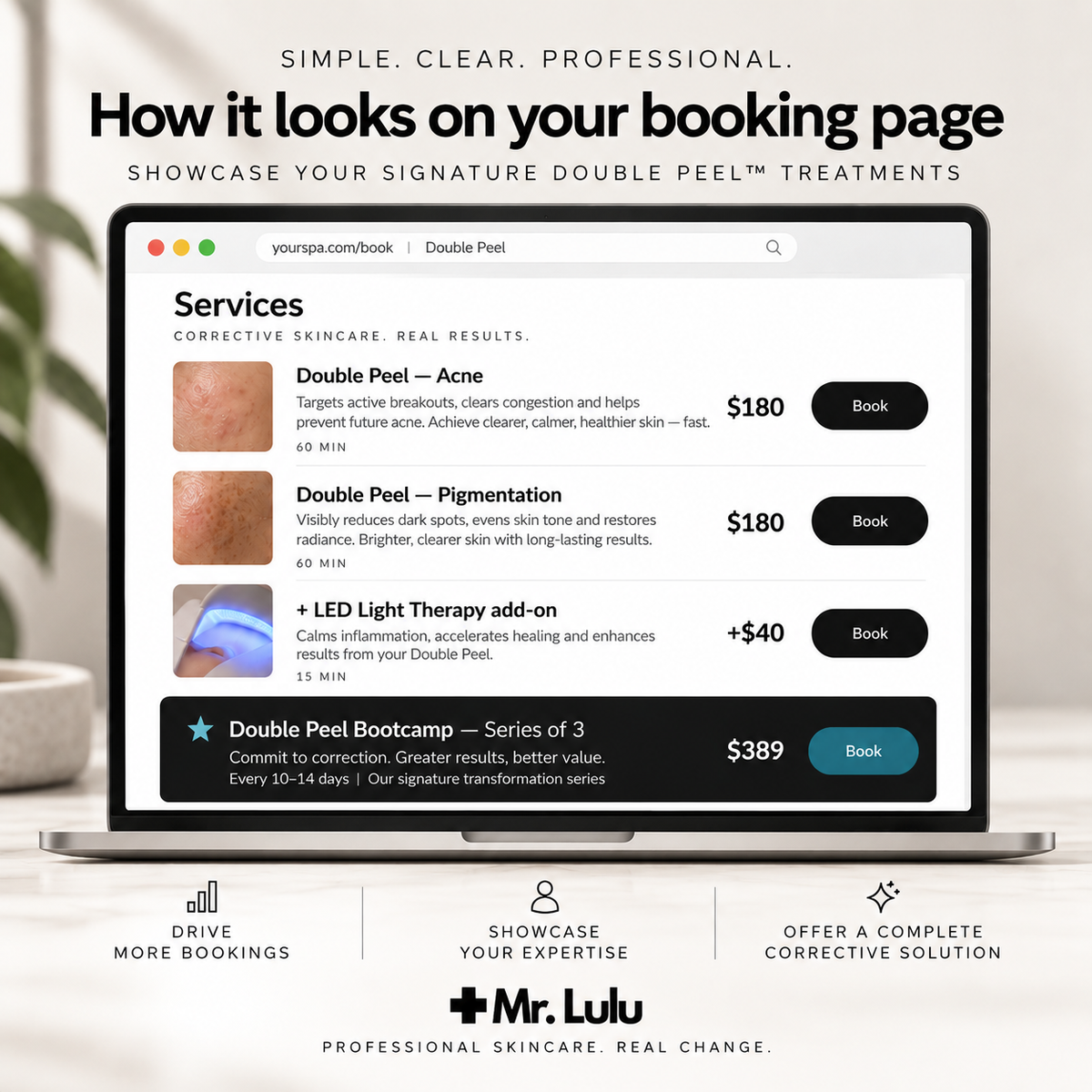
One example of this philosophy is the Double Peel™ Method from Mr. Lulu Professional Skincare.
Rather than relying on one aggressive peel, the method uses two sequential resurfacing phases: a lipid-based phase for controlled resurfacing and pore clearing, followed by a water-based phase targeting pigmentation and acne pathways.
The important difference is the technique. The practitioner adjusts the treatment according to the concern being treated and the strength of the client's barrier.
Acid selection, massage, dilution and treatment time can all be customized rather than applying one fixed intensity to every client.
Choosing Acids for Their Function
The Double Peel™ protocols use four acids with complementary roles:
- Salicylic acid — targets follicular congestion and acne-prone skin.
- Succinic acid — used in acne-focused protocols to address acne, sebum and inflammation.
- Lactic acid — provides slower resurfacing while supporting hydration.
- Azelaic acid — addresses pigmentation, inflammation, keratinization and acne.
Rather than combining acids simply to make a peel stronger, the goal is to select ingredients that perform different but complementary jobs.
Why Azelaic Acid Matters
Azelaic acid is particularly interesting for acne-prone, pigmentation-prone skin because it can address both the active concern and pathways involved in the pigmentation that follows.
This is why it features in both primary Double Peel™ approaches: Succinic + Azelaic for active inflammatory and comedonal acne, and Lactic + Azelaic for PIH, uneven tone and melasma-prone skin.
Many clients may move between the two approaches—first calming active acne and then focusing more heavily on residual pigmentation once the skin is quiet.
Corrective Doesn't Have to Mean Aggressive
More peeling doesn't necessarily mean more correction. More stinging doesn't mean a treatment is working better. And more downtime doesn't automatically mean better results.
The objective should be progressive correction while maintaining barrier integrity and minimizing unnecessary inflammatory stimulation.
A Better Approach to Melanin-Rich Skin
Melanin-rich skin doesn't need to be treated timidly. It needs to be treated intelligently.
Consult on reaction history, prepare the skin appropriately, change treatment variables gradually, treat inflammation as a pigmentation trigger and make home care an essential part of the protocol.
The most advanced treatment isn't necessarily the strongest one. It's the one that creates meaningful change without unnecessarily provoking the skin you're trying to correct.
Control the inflammation. Respect the barrier. Correct progressively.